Thursday, August 23, 2018

Bright Revolution


More chalk art from Bright used clothes.

Wednesday, August 22, 2018

Where's Dodekai?


Dodekai (really big) Ramen is a dried ramen chip-like snack. Nothing really special taste-wise, but it's popular with people that like instant noodles. They've tied up with Where's Wally (the Japanese name for Where's Waldo).


The idea is to get customers to go to the main website to get the answers for where the Deka Boy is for each package design (there are three Deka Boys per design).

Tuesday, August 21, 2018

Mister Donut DBZ Tie-in


Mister Donut is running an anime tie-in campaign with Dragon Ball Heroes, and some girl's show.


Buu is doing Fusion badly.


You can get a Fusion Donut set (a half and half donut in a DBZ cup for $4.50-$5.50), or you can get a kid's set (donut or soba plus a toy) for $3.75. Either way, you're paying a fair amount of money for a donut that doesn't taste that good, and a prize that you really wouldn't want otherwise.


"Collaboration Campaign in progress."
So, collaborate now!

Monday, August 20, 2018

3-on-3 Game


The weekend was ok this time. Kagoshima had its big annual fireworks show on Sakurajima on Saturday, which could have gone better or worse. Coming up on Saturday, I knew that I'd have to miss the fireworks because I teach English lessons at the school in the evening. But, a few weeks ago, I discovered that the display was going to be on the 18th, which is at the end of Obon, so the school was going to be closed. Yay - fireworks. However, I'm busy on the 25th with other work, so the school rescheduled my lessons from the 25th to the 18, with classes specifically from 7-9 PM. Sigh. Then, at 7 PM, the student was late because the streetcars were all so packed with people going to Dolphin Port to watch the display, and when he did arrive, he said that he could only take one lesson in order to avoid the return traffic crush. So, I taught until 8:10 PM, and then ran the 6 blocks to Dolphin Port, where I was able to watch the last 30 minutes, including the big finale. So that was good. Partial-yay!


I didn't have much reason to get out on Sunday, and was pretty much planning on just staying home. But, there were a couple things I needed at Amu Plaza, so I got out the door at about 4 PM. At that time, the Kagoshima Explorers basketball team was putting on a 3-on-3 exhibit game in the open plaza. There must have been about 200 people watching, making it difficult to get close enough to take photos. I just held the camera up over my head and took a few shots and hoped they'd turn out. For amusement, the English slogan on the fliers being handed out reads "Explorers Kagoshima - Slow But Sure." Not the best motto for a pro basketball team...


I'm not a fan of pro sports, and I don't know any of the players. So, I didn't stick long. But the game here did end a little later, and the cheerleaders came out. I would have tried to watch them, but the crowds had gotten bigger, and the women just did AKB48-style posturing, but with pompoms. I never realized that cheerleaders could be boring like that. Eventually I returned home for an early dinner, and then did work for the rest of the evening.

I liked the fireworks, anyway. I don't know of any more events coming up, until the big outdoor Jazz fest Sept. 8-9. Last year, there was a good black drummer, but it doesn't look like he's coming back this time. This year, the headlining foreign group is the Kurt Rosenwinkel Trio. Everyone else is Japanese. On the plus side, it's a free 2-day show.

Sunday, August 19, 2018

Mickey Crawls


Mickey's seen better days. But you know what they say - "Can't keep a good guy down." (Don't need to if they do it to themselves.)

Saturday, August 18, 2018

Mugen Shinshi, Mystery Stories Compilation comments


(Image from amazon.co.jp, used for review purposes only.)

Mugen Shinshi Kaikihen (Fantasy Gentleman, Mystery Stories Compilation) by Yousuke Takahashi, Grade A (1,000 yen plus tax, about 480 pages)
I've mentioned that the Maruzen Bookstore in Tenmonkan had all of the Mugen Shinshi wide edition books in one place on the horror shelves, and that I've been intrigued by Takahashi's artwork since I first encountered it over 8 years ago in Akihabara. Back then, I found the first regular volume of Mugen Shinshi, and that was my introduction to the series. Well, every time I went to Maruzen and looked over the wide books, right next to them would be the wide edition of Kaikihen, and it had a completely different cover design than the other books. So, when I finished Mugen Shinshi vol. 5, it was only natural that I'd eventually buy Kaikihen.

The earliest story in this compilation, "Ningyou Jigoku" (Doll Hell), ran in 1982 in Ryuu magazine. The remaining 19 chapters came out between 1984 and 1991, with the majority published before Dec. 1988, from Medium, Comic Again, Shonen Captain and Shonen Captain Select magazines. They all fall very clearly into the "Japanese horror" genre, and are very similar to Takahashi's other series, Gakou Kaidan (Scary School Stories, or "School Mysteries"). They're all stand-alone chapters, and Mamiya Mugen is the only common thread running through them. Here, though, with the exception of "Ningyou Jigoku," Mamiya is older, maybe in his 20's or early 30's, much more cynical, and a heavy chainsmoker. In a way, the stories have a Gegege no Kitaro vibe, where Mamiya just happens to be in the right place at the right time to encounter a monster, ghost or evil human. Other times, he acts as a detective, and then his clients visit him at his office in the family mansion to make requests for dealing with specific yokai. Overall, though, there's something of a Twilight Zone, or Night Gallery element to the tales, where no one gets out unscathed (this is Japanese horror, after all).

The character designs are a little more stylized than in the comic version of Mugen, but the background art can be incredibly detailed. The stories generally follow the same pattern - Mamiya shows up at a particular scene, the yokai is revealed, and there's some kind of conflict (either physical or intellectual) and the yokai either gets what it's after, or what's coming to it. Mamiya's primary weapon is his sense of poise, but he's also able to enter people's minds and make them experience whatever he tells them to. Again, there's little point to describing every chapter, so I'll just summarize a couple good examples.

"Numa" (Swamp). Mamiya arrives at a swamp in the middle of a forest and proceeds to fill a large glass jug with swamp water. A naked woman rises up from the middle of the pond and asks what he wants. Mamiya replies that he's just getting some water for a client, the woman answers "is that so" and sinks back into the pond. Later, Mamiya is back at his mansion, where he's visited by a young man dressed like a university student from the Showa period (1930's-40's). He takes the jar and drinks all the water. Mamiya then makes him explain himself. The guy answers that half a year earlier he'd been suffering from severe depression, and he'd gone out to the forest to commit suicide. He'd waded into the swamp, slipped over a drop off and came close to drowning. Eventually, he realized that he didn't want to die after all, and made his way back to the surface, but he'd swallowed a lot of the muddy water. He threw up most of that and went back home, where he was apparently cured of his mental misery. Some time later, he started getting painfully thirsty, but neither water nor alcohol made it stop. That's when he decided to ask Mamiya to get the swamp water for him, because he didn't want to make the trip to the forest himself. Mamiya asks if that's the entire story or if he's holding something back about killing someone. The guy laughs off the question, then drops to the ground in great pain. His chest explodes open to reveal the woman from the swamp. She smiles in victory, holding the guy's entrails in her hands, then turns to mud and just leaves a big puddle around the corpse.

"Koumori" (The Bat). Mamiya has been out of the country, and as he's returning by ocean liner, he spots a young woman with long braided black hair standing next to the railing, singing. No one else notices her. She approaches him and gets ready to kiss him, showing vampire fangs as she smiles. Mamiya blows cigarette smoke in her face and she turns into a bat and flies away. Later, he's at a tea house, relating the story to a friend. He says, "Weird story, huh?" The friend, a young man with curly black hair, just sits in his chair, silent. Mamiya asks what's wrong, and the guy tells him that a couple nights before Mamiya got back, he'd been approached by the same woman, who'd asked if he knew Mamiya. He said he did, and the woman told him that she wanted revenge on Mamiya, and that he was to bring his friend to a park at night. She then bit him in the neck, leaving two large puncture wounds. Mamiya has the guy take him to the park, where the woman is waiting. But, when the guy turns to look behind him, Mamiya has disappeared. The woman accuses him of trying to trick her, then she grabs him and lifts him into the air before threatening to drop him into the ocean to die. She turns into a small bat, and her captive falls into the water far below. A few seconds later, Mamiya is fishing his friend out of the small lake in the park (he'd been hypnotized). The guy asks where the woman has gone, and Mamiya holds up a tiny, squirming bat in his right hand, saying "Here she is." Mamiya turns to the bat and tells her, "I will forgive you this time. I won't next time." He lets go and the bat flutters off.

The last chapter is "Catch and Release," in which Mamiya encounters a giant female water spirit, seduces her, and then leaves. This is then followed by 4 pages of black and white illustrations used for past publication editions.

Summary: Yousuke does love his horror, and he's good at telling spooky stories with atmospheric twists. There is a lot more gore here than in School Mysteries, and nudity, but it's nothing compared to Hollywood movies of the same era. The art is good, and I like Mamiya's designs. I can't be sure that this volume contains all of the scary Mugen chapters, but it looks like it. Note that the Baka Updates page incorrectly calls this "Shin Kaikihen" (New Mysteries), and the 2012 publication date seems to be for a different edition reprint. If you're an adult in your country, and you like The Ring or Grudge, you'll like Mugen Shinshi Kaikihen. Recommended.

On a side note, there are maybe 10 wide volumes of Gakou Kaidan (School Mysteries), and I've only read #1. I'm probably not going to get any of the others, because they're kind of relentless in all the different ways the same students get killed off. It gets oppressive after a few chapters.

Friday, August 17, 2018

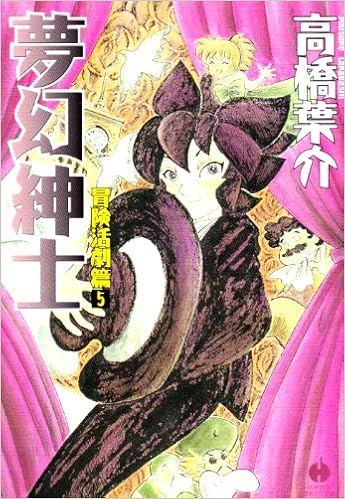
Mugen Shinshi, vol. 5 comments


(Image from amazon.co.jp, used for review purposes only.)

Mugen Shinshi (Fantasy Gentleman), vol. 5 (1990-91, Shonen Captain), by Yousuke Takahashi, Grade A (400 pages, 860 yen plus tax)
This is the last of the wide volume collection for the original Mugen series. As mentioned in the review for #4, the stories have devolved largely into slapstick gag one-shots, with Mamiya Mugen getting into silly situations and often just making them worse because he can. There are a couple stand-out chapters, though.

The first is "Mugen Neko Boken, Parts 1 and 2" (Neko Mugen's Adventure). Neko is Mamiya's aunt, an uncontrollable force for evil, head of the Neko Harem, and serial widow. In "Adventure," we get a flashback to see Neko at work, trying to "accidentally" off her new husband (she fails at that while blowing up the cruise ship they were on for their honeymoon). Neko, the deadman walking, and Alucard drift in a lifeboat to an island occupied by a devious smuggler. Neko outsmarts the smuggler and escapes with much of his wealth. To her chagrin, her new husband is still with her. In part 2, she re-encounters the smuggler and eventually kills him, all the while going topless for the entire story.

In "Konya wa Saiko" (this can be both "Tonight is Wonderful" and "Tonight is Psycho"), we get another flashback. This time with Mamiya's mother, Yukie. As a young mother, Yukie decides that she should get a job to support the family (since her husband, Kyoushiro, is so bad at stealing money on his own). However, she's a hopeless klutz and gets fired as a waitress. However, she's approached by a guy with a strange 2-tone face (the left side is white, the right side is darker), named Menda (Mask-Field). He hires Yukie on as a housekeeper to tend to his mansion while his new wife is preparing to move in. Menda goes out of his way to instruct her to not open the door in the basement with the key locked in a safe that has the combination 3261. Yukie proceeds to apply herself to her tasks, while the guy keeps coming back and telling her to stay out of the basement, and correcting her when she gets the combination wrong. That night, as she's getting ready for bed, she's surprised by Neko, who turns out to be the weird guy's new bride. They sneak into the basement, where they find a bunch of young women frozen into statue-like poses. Seems that the guy is in the same serial-widower line Neko is. The two women are then attacked by "Mother," - the weird guy in a dress and gray-haired wig. Yes, this is a Norman Bates-homage. Mother almost knifes Yukie and she calls out Kyoushiro's name for help. He's been hiding in a suit of armor, standing outside the basement room, and he bashes Menda in the head with a mace. Kyoushiro and his priest friend had been planning on stealing money from Menda, and instead Kyoushiro and Yukie take over the mansion for themselves. And to this day, Menda, in his "Mother" outfit, is still living in the basement, rocking away in his chair.

"Otone no Kuni no Mugen Shinshi" (Mugen Shinshi's Maiden Country) starts out bizarrely enough with Detective Edogawa asking Mamiya for help in rescuing his tomboy daughter, Pinko. She's fallen under the spell of Tsukiko Hanajimakaze (Moon-Girl Flower-Island-Wind), a stage actress that specializes in male impersonation and has formed her own harem of young women worshipers. Mamiya cross-dresses to infiltrate the harem to try to get Pinko to come back home. The harem quickly realizes that Mamiya is male and rips his dress to shreds before chasing him away. He and Atsuko try returning to Tsukiko's mansion, and are about to be defeated again when Neko blows a hole through the building. She tells Mamiya that Tsukiko's harem used to be her own servants. The former servants prefer someone that treats them with "love" and refuse to return to her. Tsukiko laughs in victory, and Neko empties her flamethrower at her opponent. We quickly discover that "Tsukiko" is actually a guy that likes to cross-dress. The harem turns on him at learning they've been tricked, and then happily become Neko's faithful minions again. This include Pinko, to her police detective father's dismay. Meanwhile, Kyoushiro and Yukie have taken a vacation trip to 1940's Germany, where they pick on Hitler to the point where he puts them in front of a firing squad.

Finally, we get "Souyuu wake de" (For that reason). Mamiya and Atsuko prepare to travel to Germany to rescue his parents, while all the previous supporting characters try to get in one last cameo appearance each. Mamiya and his girlfriend get on an oceanliner, which quickly sinks after a crewmember removes the "lucky" seal Kyoushiro's priest friend had put over a hole in the hull. This leaves Atsuko and Mamiya alone in the middle of the ocean in a lifeboat. Atsuko decides to take this opportunity to seduce her boyfriend, and Mamiya is willing to let her. They ignore the attempted interruption of a squadron of fighters flying overhead. Later, Atsuko wakes up to see Mamiya staring out ahead of them. It is 1942, and they've arrived at the destruction of Pearl Harbor. Armed with his pistol, Mamiya leaps into WW II. Time goes by. At some point after 1956, Detective Edogawa and his men, all old and gray-haired now, are starting to wonder if their friend Mamiya is ever going to come back home. Suddenly, a group of hooded gangsters, The Dry Z group (Dorai-Zeto), runs in and kidnaps the mad scientist the police are supposed to be protecting. The scientist invented a kid's science kit for turning people into sludge, and the leader wants to know how to control the sludge monster they've created with the kit. The scientist refuses, and is rescued by a girl in a beret and sunglasses, calling herself "Tokyo Kid, the girl without a name." Kid uses a whip to flog most of Dry Z into the sludge, but the boss tries to escape in a hot air balloon. A stranger hands Kid a Colt Pocket .25 automatic, and she shoots and blows up the balloon. She then notices the stranger, a tall man in a white suit and hat, with a thin mustache, is her father, Mamiya. The girl is named Mako (Magic-child), and her mother, Atsuko, drives up in a Bugatti, smashing it into a utility pole (making this the fifth car they've gone through so far). Atsuko says that the radio has announced a bank robbery nearby, so the family goes running off to deal with the villains.

The last illustrated story is told by the dead maid from book 4. She relates various visitors Mamiya had received at night, including Death, a girl with a dinosaur for a brother, a murderous elf, and a few others. The story ends with an older version of Mamiya arriving and asking his younger self if he wants to go out for a drink. The two walk off into the sunset, accompanied by the bloodied dead maid.

Summary: Oh man, what a ride. Lots of weirdness, dark humor and straight-out slapstick, with parodies or cameos of Gegege no Kitaro, Boris and Natasha, and the monolith from 2001: A Space Odyssey (treated as one in a long line of dominoes). I love the character designs, and the background art is highly-detailed and well-rendered. Book 5 probably was the best place to end the series, while it was still riding on a high note. There's no real graphic violence or sex, but this book especially has a lot of naked breasts. If that bothers you, or if you're underage, I don't recommend Mugen Shinshi. For everyone else, check this out.